
I began running in April 2025 and by year-end I covered 600 km and raced five times—three 5 km and two 10 km events. This effort changed how I breathe, recover and view my fitness overall, and since I got my first real running watch my focus swithced to the question: What is VO2 max?
This guide will explain that VO2 max is a single-number summary of cardiorespiratory fitness, showing how heart, lungs, circulation and muscles team up. You’ll learn why devices show that number and how to interpret it, rather than ignore it.
Expect clear sections on definition, physiology, testing in the UK, wearable estimates and typical ranges. You’ll see how better scores link to less breathlessness, quicker recovery and stronger endurance in races and daily activity.
And just to remember: VO2 max matters, but economy, lactate threshold and motivation also shape performance. Use this guide to compare your current level, track trends and train safely to raise your aerobic capacity and overall health.
Key Takeaways
- The guide decodes the VO2 max figure seen on watches and apps.
- It links the number to real-life gains: less breathlessness and faster recovery.
- Coverage includes testing options, wearable estimates and typical ranges in the UK.
- Vo2 max is a useful benchmark, not the only determinant of performance.
- You’ll learn to track trends, compare levels and train to improve aerobic fitness.
What is VO2 max and what does it measure in your body?
Your watch may have shown a single number that summarises how well your body uses oxygen during hard exercise.
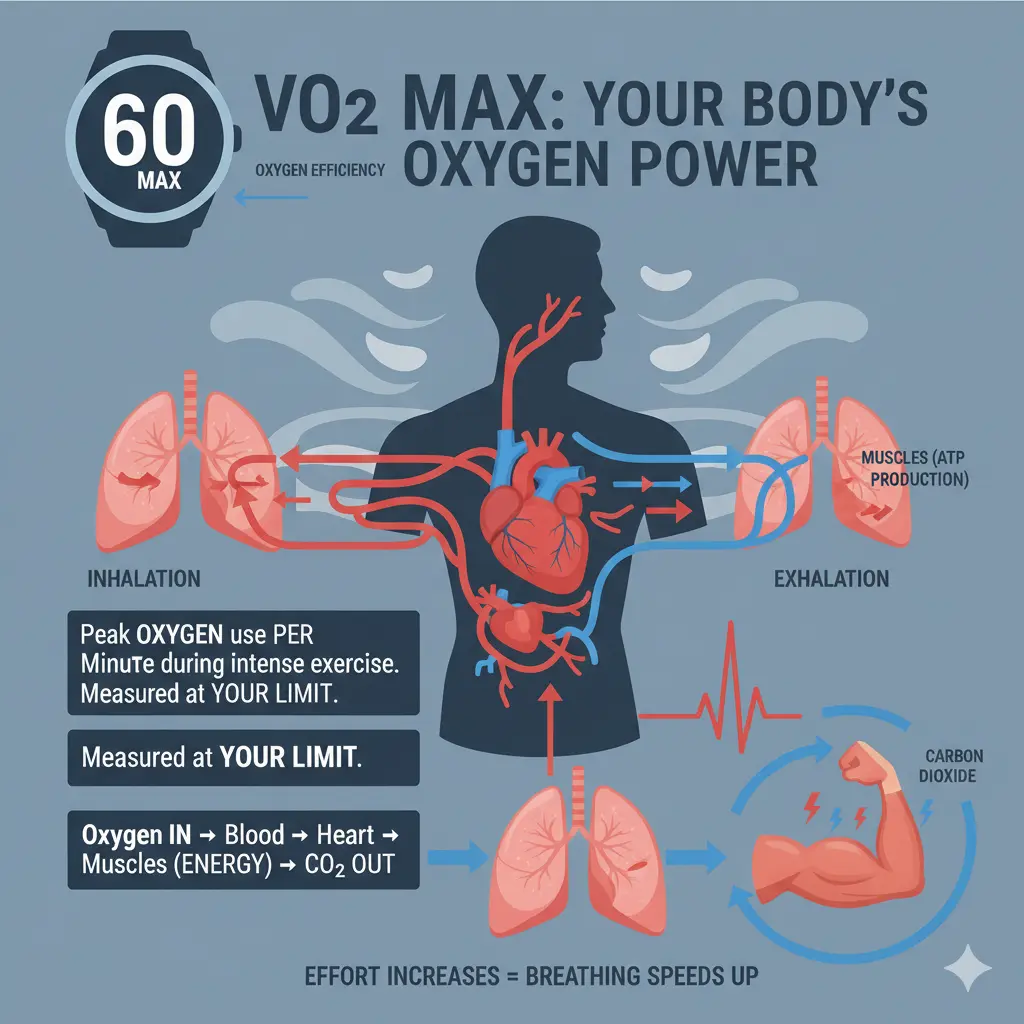
The meaning of VO2 max. In plain terms, this figure represents the peak amount of oxygen your body can use per minute when intensity is very high. It’s measured at your limit because that shows the highest sustained rate your system can manage.
Air enters your lungs, oxygen crosses into blood, the heart pumps it around, and muscles use it to produce ATP — the energy your cells need for contraction.
As oxygen is used, carbon dioxide is made and expelled when you exhale. That link explains why breathing rate rises as effort increases.
Units and why per kilogram matters
This value is usually given as mL/kg/min — millilitres of oxygen per kilogram of body weight per minute. Relative numbers help compare people of different sizes fairly.
- Rate/volume concept: oxygen used over time (hence “per minute”).
- Reflects aerobic capacity and overall cardiorespiratory fitness.
- Shows how well lungs, heart, blood and muscles work together.
Why VO2 max matters for your fitness, endurance and long-term health
A stronger aerobic score changes both your training and daily energy, letting you keep up pace for longer. It reflects how well your body takes oxygen from the air, moves it via the heart and blood, and uses it in working muscles.
With more usable oxygen you create more ATP aerobically at a given pace. That means you can hold faster speeds for longer without shifting to heavy anaerobic effort.
This matters in sports such as running and swimming, where sustained oxygen delivery determines how well you maintain pace and finish strongly.
Better cardiorespiratory fitness often tracks with lower risk of heart disease, diabetes, stroke and some cancers. Using a reliable aerobic metric gives a simple way to quantify that protective fitness.
Everyday wins you may notice
You’ll likely climb stairs with less breathlessness, recover quicker after a hard session and feel less “wrecked” after brisk activity. Even non-athletes benefit: improved stamina changes day-to-day activity.
- Better stamina for longer exercise and daily tasks.
- Faster recovery between efforts and training sessions.
- A practical benchmark to track training gains over time.
Remember that genes and training both shape your starting point. Your trend over months is more actionable than a single reading, whether you’re an athlete or improving your fitness level for health.
I first came across VO2 max when I was watching Limitless with Chris Hemsworth. I really liked the episodes with Dr. Peter Attia, He was very educative about why this metric is important for longevity. Since then, I bought his book, Longevity and started running 3 times per week.
One thing I should try soon is fasting, but thats a different story.
How VO2 max works during exercise intensity
As you step up intensity, your demand for oxygen climbs. The lungs pull in more air, the heart pumps faster, and blood flow redirects to active muscle groups. Together, these changes raise your capacity to make aerobic energy for each stride or pedal stroke.
Your lungs increase ventilation to move more oxygen into the blood and clear carbon dioxide. Heart rate rises so the circulation can deliver that oxygen quickly. Blood vessels dilate in working limbs, sending oxygen-rich blood to the muscles that need it most.
Aerobic work relies on steady oxygen delivery to produce energy. Anaerobic effort taps short-term chemical stores when oxygen supply can’t keep pace. The VO2 max figure marks the ceiling for sustained aerobic power — beyond that, you rely more on anaerobic pathways.
Why 100% cannot be sustained and how that affects pacing
Sitting at 100% is extremely demanding. Carbon dioxide and fatigue accumulate fast, and you lose metabolic control. That’s why your best steady race pace sits below the ceiling, even though training at or near it can raise your level over time.
- Near the ceiling you’ll breathe very hard and struggle to speak.
- Short, repeated efforts at high intensity help increase the ceiling for future endurance.
- Pacing wisely keeps you below the limit so you can sustain effort for longer.
The highest VO2 max ever registered by human
Norwegian triathlete Kristian Blummenfelt holds the highest recorded VO2 max, with a reported lab-tested score of 101.1 ml/kg/min, as of February 2026 – according to Triathlon Magazine Canada.
A bejegyzés megtekintése az Instagramon
How VO2 max is measured and tested
Testing options range from clinical lab protocols to local field runs, each offering a trade-off between accuracy and convenience.
Lab testing on a treadmill or bike
Gold-standard lab tests use a face mask that samples inhaled and exhaled air while you run on a treadmill or ride a cycle ergometer.
Technicians increase speed or resistance stepwise until your oxygen uptake peaks. The analyser compares oxygen and carbon dioxide levels to give a direct reading.
These tests are the most precise but demanding, so they should be done when you are healthy and under supervision.
Submaximal tests
Submax checks stop short of full effort, often around 85% of true heart rate. They suit beginners, clinical screens and people who must avoid extreme strain.
They use predictable protocols and formulas to estimate aerobic capacity with less risk, though accuracy falls short of lab measures.
Common field options
Accessible tests include the Cooper 12-minute run, Rockport 1-mile walk and the multistage shuttle (bleep) test.
All you need is a measured route or track and a stopwatch. These give comparative scores for tracking progress rather than absolute precision.
Heart-rate ratio method
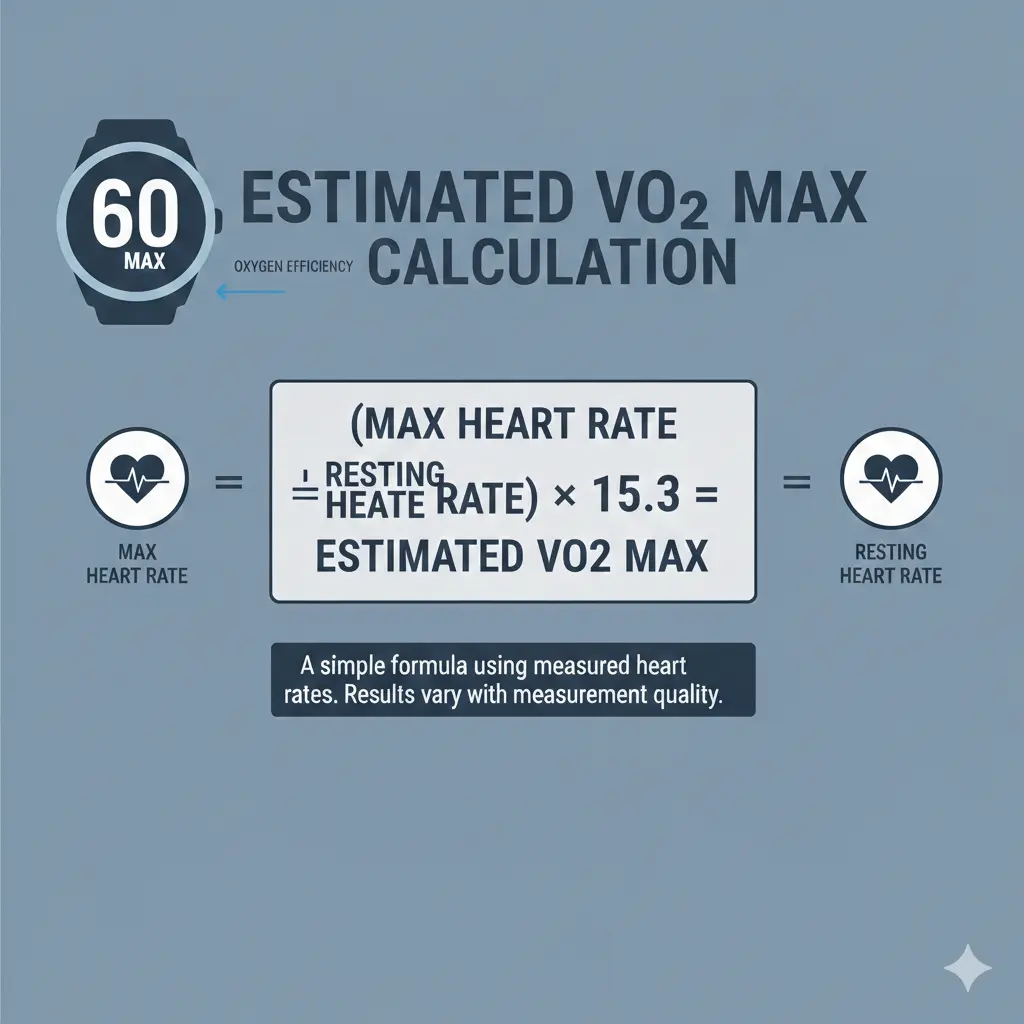
A simple formula uses your measured resting and true maximum heart to estimate value: (max heart ÷ resting heart) × 15.3. Results vary with measurement quality.
For runners, repeat the same field test under similar conditions to cut noise and better track real change over time.
- Lab: high accuracy, supervised.
- Submax: practical, safer for many people.
- Field: cheap, repeatable, great for runners to monitor trends.
Using smartwatches and wearables to estimate VO2 max over time
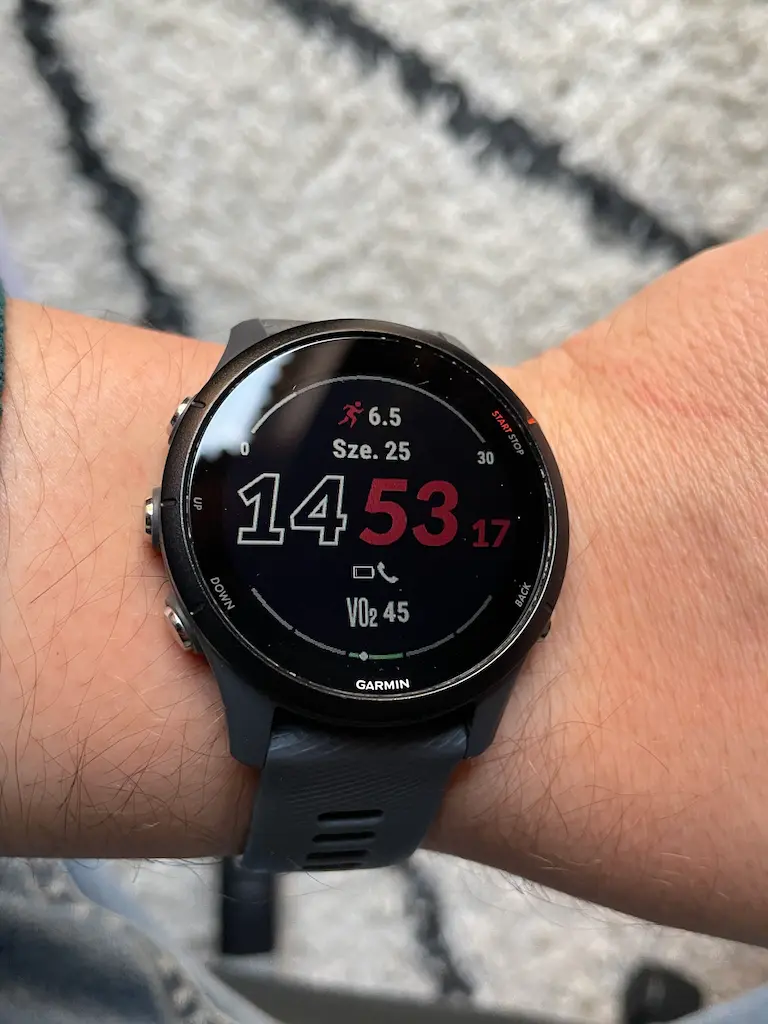
Modern watches blend speed and heart signals to estimate aerobic capacity on the move. They never measure oxygen directly. Instead, they model how fast you go for a given effort and convert that into an estimated VO2 max number.
Wearables pair pace (or power on a bike) with heart rate to infer how hard your body works at each speed. As your fitness improves, you run faster for the same pulse, and the device updates its estimate.
One reading can mislead: fatigue, heat, illness, sleep or a loose strap distort results. Track weekly and monthly patterns to spot genuine gains in fitness level and higher vo2 rather than chasing every change.
Sensor accuracy and practical tips
Wrist optical sensors can wobble during hard efforts. Chest straps usually give cleaner heart-rate signals, especially during intervals or cold weather.
- Fit the device snugly and warm the skin before hard sessions.
- Repeat similar efforts for consistent comparisons.
- Use a power meter for cycling to improve estimates.
Treat your watch as a supportive tool for improving vo2 over time, not a medical-grade test.
What’s a good VO2 max for your age and sex?
Age and sex shift the meaning of a given aerobic score, so a single figure rarely tells the whole story.
Why “good” depends on your personal context
Your background matters. Genetics, training history and body composition all shape the level you start from and can reach.
A value that ranks highly for younger people may sit lower for older adults, and men and women follow different normative patterns.
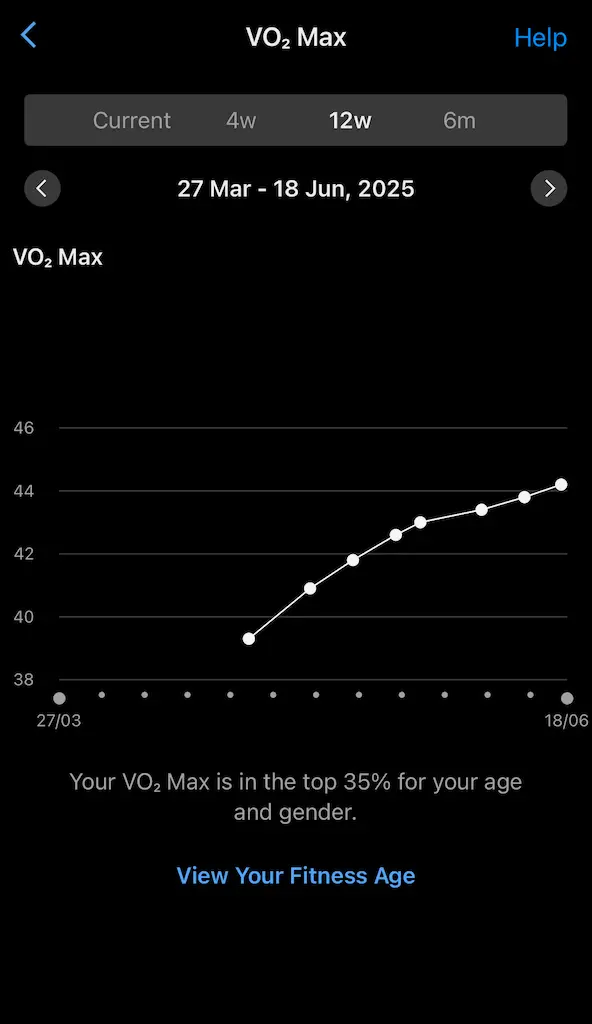
When I started running, I hardly were able to run 3,5 kilometers. It took me about a month to push above 5k, my first VO2 max scores was about 39, and since then slowly climbed up to 46 thanks to the weekly training.
Typical ranges and how normative tables work
Normative tables split people into age bands and label ranges such as superior, good, fair and poor. UK tools — including Garmin Connect — compare you to others of the same age and sex to give a percentile.
Falling into “good” for your band means you outperform many peers; “fair” suggests room to improve but not a health alarm on its own.
Percentiles, examples and practical benchmarking
A reading of 40 mL/kg/min might be excellent for an older woman, average for a middle-aged man and modest for a young athlete. Percentiles tell you where you sit among similar people and show realistic targets to climb.
- Use percentiles to track steady gains rather than chasing single numbers.
- Combine the number with pace at a given heart rate and recovery to judge real progress.
- Remember factors such as altitude, testing method and body weight can skew comparisons.

Key factors that affect VO2 max: genetics, training, age, altitude and body weight
Some influences on your aerobic score come from genes you cannot change, while others respond well to steady training and life choices.
Genetics and natural potential
Your inherited traits shape heart size, lung capacity and how efficiently blood carries oxygen. That sets a ceiling on the gains you can reach.
Focus on realistic targets: training raises your score, but genetics partly determine the top end.
Sex and body composition
Average differences come from lean mass and organ size. More muscle and larger hearts or lungs usually lead to higher readings.
Elite female athletes often out-perform average men, showing training and composition matter more than simple averages.
Age-related decline
Scores tend to peak around your 30s, then fall by roughly 5–10% per decade. After 70, the drop often speeds up.
Lower maximum heart rate, reduced stroke volume, less efficient muscle and shifts in body weight all play a part.
Altitude and environment
Sparser air at height reduces oxygen uptake, so measured values fall away from sea level. Compare tests only under similar conditions.
Body weight effects
Because figures usually read per kilogram body, losing excess fat can raise your relative number even if absolute oxygen use stays similar.
- Train consistently to lift the trainable portion of your score.
- Improve body composition to raise relative results.
- Account for age and altitude when comparing readings.
- Set realistic goals based on your genetic baseline and health.
Relative vs absolute VO2 max: understanding the numbers you see
Your device most often reports a size-adjusted figure. That gives oxygen used per kilogram per minute and helps you compare people of different sizes.
Relative value shown on watches
Relative figures use millilitres per kilogram per minute. Wearables like Garmin display this number because it levels the playing field between light and heavy users.
Absolute volume for total capacity
Absolute value gives total oxygen volume per minute. You can estimate it by multiplying the relative figure by your body weight in kilograms.
- Relative = mL per kilogram per minute (common on apps).
- Absolute = relative × body weight (kg) = total mL per minute.
- Use relative for running and general fitness comparisons; use absolute to judge whole-body capacity for cycling or rowing.
Why lighter with the same engine often wins
If two people share the same absolute engine but differ in weight, the lighter person has a higher relative reading. In weight-bearing sports, that higher per-kilogram number usually boosts performance.
Note: losing weight can raise your displayed number even if underlying aerobic machinery stays unchanged. Track both metrics so you interpret progress correctly.
How to improve VO2 max safely with training volume and intensity
Consistent change comes from two clear levers: increasing easy volume and adding precise high-intensity sessions. Together they raise your aerobic ceiling while limiting injury risk.
Build your base
Base training means conversational-pace miles or rides that add weekly time without heavy strain. This boosts circulation, capillary density and mitochondrial work with low recovery cost.
Keep most sessions easy and steady. Aim to increase total weekly minutes gradually rather than suddenly upping hard efforts.
VO2 max intervals and heart-rate guidance
Target intervals at roughly 90%+ of your max heart rate to recruit the aerobic fibres that lift the ceiling. If heart rate lags, use perceived exertion—very hard but controlled effort.
Sample sessions
- Running: 6×1 km at sharp race pace with 60–90s recoveries, or 4×3 min hill repeats for form and power.
- Cycling: 5×5 min hard efforts inside a longer ride, with ~2 min easy spinning between reps; many athletes hold 3–8 min per rep.
- Swimming: 10×100 m or 20×50 m hard repeats with steady, timed rest; focus on consistent pace and technique.
How long it can take
Novices may notice improvements within a few weeks and can see sizable relative gains. Well-trained athletes usually need longer, with smaller incremental lifts.
Safety tips: progress gradually, avoid back-to-back hard days, and scale sessions when ill, tired or under stress. That keeps gains steady and durable while lowering injury risk.
What is VO2 Max? Conclusion
Think of your aerobic number as a compass that guides training choices rather than a final destination.
It summarises how well your body uses oxygen at high intensity and gives a clear number you can track over weeks and months.
Higher aerobic fitness links to better endurance and long-term health. Choose the test that suits your life: lab measures for precision, field tests for simplicity, or a smartwatch for frequent estimates.
Focus on trends, not single readings. Combine steady aerobic volume with carefully dosed intervals, review your levels every few weeks and adjust training to stay consistent and injury‑free.
Keep context in mind — age, sex, body composition, altitude and the test method all shape results and help you set realistic, motivating targets.